One of my first memories is myself, 5 years old, going to my mother and declare to her, as serious as only children can be: “I will be a scientist.”
Yesterday night I was in my office in the Department of Chemistry at the University of Cambridge packing my stuff, resolved to not go back to research again -at least not in the shortcoming future.
What has gone wrong?
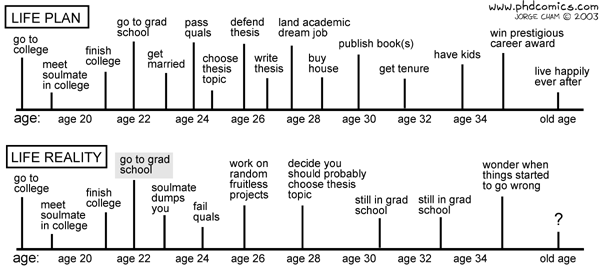
I could write in detail what was horribly wrong with my project, and for sure having a lousy project played a big part in deciding to stop and change my path. You for sure want to change your path if you find yourself in a mosquito-ridden swamp.
But if this was the only problem, I would have simply switched to another lab. That’s what I thought until not too long ago (even if the idea of quitting was really in my mind since a lot of time). But the problem is the practice of science itself.
Don’t get me wrong. Every scientist goes on to do science for a single reason: the love of science. Science doesn’t make you rich, it doesn’t make you famous (can you tell me the last 5 Nobel Prizes for chemistry without looking on Wikipedia? I can’t either) and doesn’t make you comfortable. The only sane reason for starting to do science is the dispassionate love of science itself. And I loved science. Like nothing else. Since I was 5 years old. And I still love it.
But one thing is to love science; a completely different one is doing it. Like the proverbial sausage, you don’t want to know how it’s done.
Actually, doing science per se is great. Doing experiments, analyzing data, making calculations, programming code: I loved it all immensely.
However, with the partial exception of mathematics and theoretical physics, you can’t be a lone wolf in science. You need funding, you need instruments, you need resources. You need other people. And here’s where the problems lie. You basically face two choices.
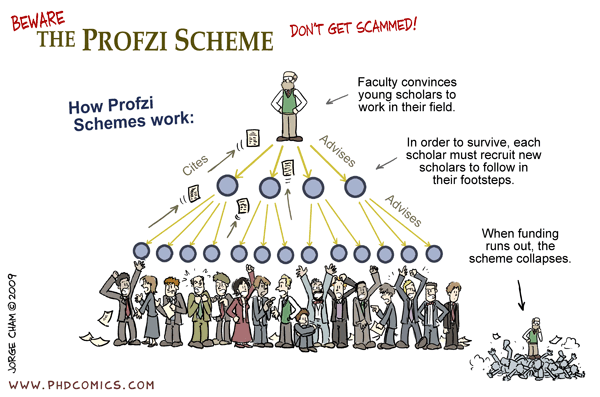
No, it's not a satire or an exaggeration.
The first is going for the sky: doing great science in a first-class place, make a great curriculum and look for a tenured position in the end. The problem is that a lot of clever people want to go for the sky, and there is much more people who want the sky compared to the available positions. In general, science career is a race, where three people go to the podium and all the others sooner or later will go back home (See also this article from the Economist on the problem). The competition for funding and positions means that not only the hopes of getting a job are really lousy, but that people become nasty. Like, really nasty.
I know of people that have given a purportedly crippled software to a collegue to sabotage his project. I’ve been violently attacked verbally for having dared talking with my supervisor of a project I was collaborating with, because she feared that I wanted to “steal” her credit. And I can’t blame her: she was “helped” by another postdoc when she first came in Cambridge, only to find all credit for her work taken by the nice and smiling guy who scammed her by “helping” her. There are endless horror stories like that. Everywhere. Now, do you want to work in a place full of insanely clever people who are also insanely cynical and determined to do everything to get on top of you? If so, you can do top level science.
It’s not all, of course. Top level science requires also an absolutely mind-boggling determination and, overall, confidence in yourself. To properly do science you must be absolutely sure that, whatever you have in mind, you will do it, no matter what, and that you’re doing it right, to the point of almost self-delusion. This is so important that who wins in science is regularly not the most brilliant but the most determined (I’ve seen Nobel prizes speaking and half of the times they didn’t look much more brilliant than your average professor. Most of them were just lucky, and overall were incredibly, monolithically determined). Combined with the above, this means working 24/7, basically leaving behind everything in your life, without any doubt on your skills and abilities and most importantly on your project, while fencing off a competition of equally tough, confident and skilled guys.

A friendly post-doctoral scientist in your group asking for a scientific collaboration.
The ones I’ve seen thriving in Cambridge, apart from geniuses (there are a few), are the guys who cling to a simple ecological tenet: Find your niche, where you are indispensable, and keep it in your claws at all costs. This means basically that these people do always the same thing, over and over again, simply because it’s the lowest-risk option. I could have done the same (I was pretty skilled during my Ph.D. in a quite obscure but interesting biophysics experimental technique) but I thought that doing science properly was also about learning and broadening your expertise. How wrong I was.
You can imagine yourself what does it mean also for research in general: Nobody takes risks anymore. Nobody young jumps and tries totally new things, because it’s almost surely a noble way to suicide your career.
There is a second option, which is bare survival. You go from postdoc to postdoc, perhaps end up as a long-term researcher somewhere in some tiny university or irrelevant research center (like CNR in Italy) and basically spend your time with a low pay, working on boring projects, crippled by lack of funding and without any hope of a reasonable career (because the career path is taken over by the hawks above described), nor any hope of stability in your life.
Notice that, again, both paths do not offer you any guarantee of sort. You can arrive to tenure track (itself an achievement) and being kicked out after a few years, thus ending up as a jobless 40-year something, with a family probably, too old to compete in the market of real jobs. And bare survival is not easy as well.
So basically, if you are not cut for this kind of life, your chances are zero. I tried, believe me. I tried hard. What happened during my research career is that I spent 6 months on antidepressants, I got a permanent gastritis, I wasted at least two important sentimental relationships, and I found all my interests and social life going down the drain.
All of this for having a couple papers about modeling obscure aspects of protein behaviour, papers that will be probably lost within the literally thousands of papers that come out every day? Until not so long, I thought that it was worth it. It was something that I had never questioned so far. I wanted to be a scientist since when I was five. I had done everything to become a scientist. I was a scientist in one of the top universities of the world, in one of the top five research groups on the subject. I had won a personal fellowship to fund myself. Most of my self-esteem, of my very concept of self-realization, relied on myself being a scientist. The very idea of quitting academia was a synonim of personal failure.
It has been long and painful to discover that it was just an illusion. When I found that academia was not working for me, I got immediately depressed -my whole worldview was crumbling. Then I remembered that I had a life. I liked my life. I had a billion things that I loved to do. I want to do them again. Quitting and reclaiming back your life is not failing. It is waking up and winning.
A week ago I was with friends, talking about my job, and I found myself comparing science to a drug addiction. Being a scientist, from the brain chemicals point of view, is one week of adrenaline rush when you’re finally on to something and pieces go together -followed by six months (if you are lucky) of pain and suffering, only to get again that adrenaline shot.
Well, noble addiction as it is, it is toxic the same. The next month I’ll be 30. It’s really time to get my life back.